I absolutely love reading interviews with published authors and illustrators, they are so inspirational. But have you ever wondered how an interview with an unpublished author would go?
(These questions have been inspired, OK copied pretty much, from the wonderful Kids’ Book Review website)
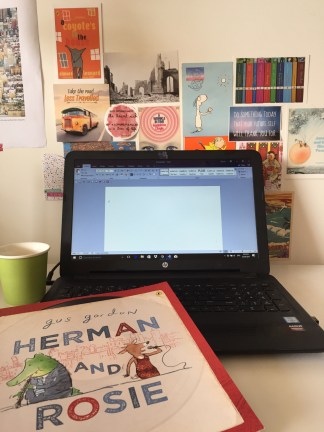
- What does a typical day look like for you?
I get up at 7am, and immediately turn on the coffee machine. I have of course been pressing snooze on my alarm since 4am because I live in hope that one day I will be like Murakami, rising at 4am and writing for 5 hours, before running 10km. Ha!
Get the kids out the door for school and Uni, then begin my daily writing routine.
Daily writing routine:
Step 1: Pick up Herman and Rosie and re-read it for the thousandth time while shedding a few tears because:
- the story is so beautiful.
- it is set in New York, and I especially want to go to New York.
- I realise I will never write or draw anything remotely as wonderful as Gus Gordon does.
Step 2 – Do some menial jobs around the house such as vacuuming or washing up, as this is when I get my best ideas.
Step 3 – Write my new ideas down in one of my many, many, idea notebooks.
Step 4 – Sit down to write a book using one of my ideas.
Step 5 – Remember that an idea is not a story. The idea is not much use without a story and a ‘voice’.
Step 6 – Go searching for this elusive story and voice. Try all the usual places, under the lounge cushions and in the letterbox.
Step 7 – Pick up Herman and Rosie again. Repeat steps 1-6 at least one more time, before giving up and settling down to do my Uni work.
2. Tell us something hardly anyone knows about you.
When I was in Primary School, I wrote masses of love songs and poems, and sent them all to Boy George. I am still waiting for one in return.
3. Describe your writing style in 10 words.
In the process of being discovered, unearthed, and explored.
4. Tell us five positive words that describe you as a writer.
Aspiring, hopeful, little red caboose.
5. What book character would you be, and why?
Rosie from Herman and Rosie. She lives in New York, she can sing Jazz, and she has a friend who is an oboe playing crocodile.
6. If you could only read one book for the rest of your life, what would it be?
Possession by A.S. Byatt. I have read it multiple times, but I skip all the tricky Victorian poetry. If I got tired of reading it, I could tackle the poetry and that would keep me going for quite a while longer.
7. What keeps you going as an unpublished writer for children?
I have this vision of seeing a child literally hugging a book that I have written, and I hope to see it come true one day.
 Lauren Child commented during her recent
  jostaker.com